
Other tests
NNAT test guide for parents
The NNAT is the Naglieri Nonverbal Ability Test, a Pearson test built only from shapes and figures, with no words in the questions. It involves skills such as completing a pattern, reasoning by analogy, following a series and picturing shapes in the mind.

Key takeaways
- The NNAT, published by Pearson, is nonverbal only: its questions use figures and shapes, not words, so it depends less on reading and vocabulary.
- Its questions involve pattern completion, reasoning by analogy, serial reasoning and spatial visualization, like finding a missing piece or the next step.
- The CogAT Nonverbal battery (Figure Matrices, Paper Folding, Figure Classification) practices closely related skills, though the formats differ.
- Teach your child to check every part of a figure, name the rule out loud, and picture the answer before looking at the choices.
- Start with real blocks, buttons and paper for a few minutes a day, and ask your school how long the test lasts, how it is given and how results are used.
On this page
The basics
The NNAT® is the Naglieri Nonverbal Ability Test, published by Pearson. It is a nonverbal test only: the questions are built from figures and shapes, not words. Children look at designs, notice how they are organized, and choose the answer that fits.
Because the test is picture-based, it looks quite different from a reading or spelling test. Practical details, such as how long it lasts, how it is given and how results are used, depend on your school, so ask your school or district if you have not been told.
Why nonverbal tests are used
A nonverbal question uses shapes and patterns to ask its question, so a child does not need to read or to know a lot of English vocabulary to work through it. That makes a picture-based test one way to look at reasoning that depends less on language.
For parents, the practical meaning is simple: vocabulary flashcards are not the point here. What helps is careful looking, noticing rules and picturing shapes in the mind. Schools choose their tests for their own reasons, so if you want to know why your school uses the NNAT, it is fine to ask.
The kinds of questions, in plain words
NNAT questions involve skills such as pattern completion, reasoning by analogy, serial reasoning and spatial visualization. Here is what each of those means in everyday terms. These are plain descriptions of the reasoning, not copies of real test items.
Pattern completion
A larger design has a piece missing, like a puzzle with one hole. Your child studies how the lines, shapes and shading run across the design and picks the piece that lets the pattern continue without a break.
Reasoning by analogy
A figure changes in a certain way: it gets bigger, turns, or changes its shading. Your child works out the change and applies it to a different figure. It is the same idea behind Figure Matrices on the CogAT®, shown in the sample below.
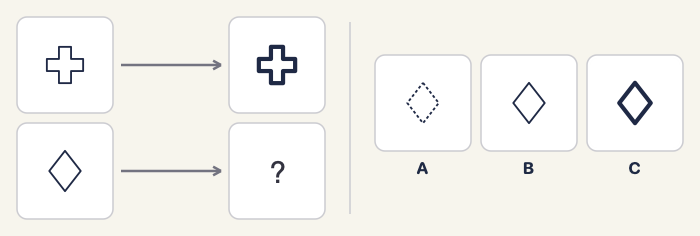
The plus sign changes in a certain way. Which answer shows the diamond changed in the same way?
Show the answer
Answer: C. The outline gets thicker, so the thin diamond becomes a thick diamond. B is unchanged and A changes the line style in a different way.
An original practice question from Thinkling, in the same format as the test. Not a real test item.
The sample is an original practice question in the CogAT Figure Matrices format, not an NNAT item. It shows the “find the change, then apply it” thinking that analogy questions use.
Serial reasoning
Figures change step by step: a dot moves one corner around a square each time, or a shape gains one line at each step. Your child finds the step and predicts what comes next.
Spatial visualization
Your child pictures shapes in the mind: how pieces fit together, how a figure looks after it is turned, or how parts combine into a whole. It is the same kind of thinking you use when doing a jigsaw puzzle or packing a car trunk.
Overlap with the CogAT Nonverbal battery
The CogAT has a Nonverbal battery with three subtests. Their formats are not the same as the NNAT’s, but they practice closely related skills:
- Figure Matrices: find how one figure changes into another and apply the same change to a new figure. Closest to reasoning by analogy.
- Paper Folding: picture where the holes appear when a folded, punched paper is opened. A hands-on way into spatial visualization.
- Figure Classification: decide what a group of figures has in common and which answer belongs with them. It trains the careful comparison that pattern questions need.
Whichever test your child takes, the habits are the same: look at every part of a figure, name the rule in words, and picture the answer before looking at the choices.
Prep tips for young children
- Start with real shapes. Blocks, buttons and paper cut-outs make rules visible. Build a pattern on the table and leave a gap for your child to fill.
- Say the rule out loud. “Each one gets one more side.” Naming the rule turns a hunch into something your child can check.
- Check every part. Shape, size, shading, direction and position. When two things change at once, the second one is easy to miss.
- Predict, then look. Ask your child to imagine the answer before scanning the choices, so a look-alike choice is less tempting.
- Fold and turn things. Folding paper, turning a cut-out shape on the table and looking at shapes in a mirror build spatial sense in a few minutes.
- Keep it short and kind. A few minutes a day is plenty. When a mistake happens, find the rule together instead of just showing the answer.
For more screen-free ideas, see our logic games for kids.
What Thinkling covers
Thinkling is primarily a CogAT prep app, and it also includes NNAT-style practice with pattern completion, figure series and matrices. Questions are original, and when an answer is wrong, the explanation shows what happened with pictures and voice before your child tries again. It does not cover every part of the NNAT, so use it for the overlapping skills and ask your school for anything specific to the test.
Frequently asked questions
What does NNAT stand for?
NNAT stands for the Naglieri Nonverbal Ability Test, published by Pearson. It is nonverbal only, which means its questions are built from figures and shapes rather than words. The questions involve skills such as pattern completion, reasoning by analogy, serial reasoning and spatial visualization.
Does my child need to read to take the NNAT?
The questions themselves are made of shapes and figures rather than words, which is why nonverbal tests depend less on reading and vocabulary. How directions are given, and what the testing session looks like for your child’s grade, are good questions to ask your school before test day.
How is the NNAT different from the CogAT?
The NNAT is nonverbal only. The CogAT has three batteries (verbal, quantitative and nonverbal) with nine subtests in total. The CogAT’s Nonverbal battery, made up of Figure Matrices, Paper Folding and Figure Classification, uses similar figure-based thinking, so practice for one supports the other even though the question formats differ.
Can you prepare for a nonverbal test?
You can’t memorize answers, but you can help your child get comfortable with this kind of thinking. A child who knows to check every part of a figure, name the rule and picture the answer before choosing has a clear plan for each question, which makes the test feel less strange. Short, playful practice with shapes is enough.
Does Thinkling include NNAT practice?
Thinkling includes NNAT-style practice with pattern completion, figure series and matrices. It is primarily a CogAT prep app covering all nine CogAT question types, so it does not claim to cover every part of the NNAT. Every question is an original practice question, not a real test item.