
Free printable
Free printable CogAT practice test
This free printable CogAT practice test has 14 original questions: nine picture questions for kindergarten to 2nd grade, one of each question type, and five word and number questions for grades 3–5. Print it or save it as a PDF; the answer key is at the end.

Key takeaways
- Print this page with your browser’s Print command, or choose Save as PDF in the print dialog to keep a PDF copy.
- Part 1 has nine picture questions for K–2, one per CogAT question type; Part 2 has five word and number questions for grades 3–5.
- For K–2, read each question aloud once and use no timer, since the real test at those levels is read aloud and teacher-paced.
- Give no hints during the test, then go through the answer key together and ask your child how they chose.
- These are original practice questions in the CogAT formats, not real test items, and the result is not a CogAT score.
On this page
How to print it or save it as a PDF
- Keep the answers hidden. Each question has a “Show the answer” button. Leave them all closed, so the answers don’t appear on the printout.
- Open the print dialog. Use your browser’s Print command: Ctrl+P on Windows or Command+P on a Mac. On an iPhone or iPad, tap the Share button, then Print.
- Pick the pages you need. The preview shows the whole page. To print only the test, choose the pages that hold Part 1, Part 2 and the answer key.
- Want a PDF instead? In the print dialog on a computer, choose Save as PDF as the destination (or from the PDF menu), then save the file to print later.
Fold or cut off the answer key before you start, so it stays with you.
How to give it like the real thing
A printout at the kitchen table can feel quite close to the real CogAT® if you keep a few simple rules. Clear the table, put phones away, and give your child a pencil to circle the letter of each answer. Sit beside them, not across from them, and keep your face neutral as they choose.
Kindergarten to 2nd grade: you read, no clock
At Levels 5/6 to 8, usually kindergarten to 2nd grade, the teacher reads every question aloud and paces the group, and there is no time limit. Do the same at home with Part 1. Read the words in each question box once, clearly, then wait. Don’t repeat the question, give hints or react to the choice; “Pick the one you think is best” is all you need to say.
Young children can split Part 1 into three short sittings, one per battery: questions 1–3 are verbal, 4–6 quantitative and 7–9 nonverbal.
Grades 3–5: your child reads alone
From Level 9, usually in 3rd grade, children read the questions on their own, and each real subtest is timed at 10 minutes. Five questions are too few to time meaningfully, so let your child work through Part 2 at a steady pace and focus on reading every choice. Add questions 7–9 from Part 1 too: the nonverbal format is the same at every grade.

These are original practice questions from Thinkling, in the same formats as the CogAT. They are not real test items, and 14 questions show the formats; they can’t predict a CogAT score or percentile.
Part 1: K–2 (picture questions)
Read each question aloud for your child. Every answer is a picture, so no reading is needed.
Question 1: Picture analogies
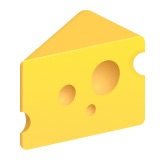
Read aloud: “Look at the first two pictures. They go together. Which picture goes with the mouse in the same way?”






Show the answer
Answer: A. A rabbit eats a carrot, so a mouse eats cheese. The carrot is a trap: it belongs to the first pair, not to the mouse.
An original practice question from Thinkling, in the same format as the test. Not a real test item.
Question 2: Sentence completion
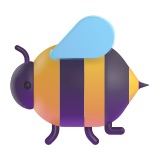
Read aloud: “Which one makes honey?”




Show the answer
Answer: B. Bees make honey. The spider and the butterfly are small animals too, which is what makes them tempting.
An original practice question from Thinkling, in the same format as the test. Not a real test item.
Question 3: Picture classification
Read aloud: “These three pictures are alike in some way. Which picture goes with them?”







Show the answer
Answer: B. A shark, a fish and a crab all live in the sea. So does a whale.
An original practice question from Thinkling, in the same format as the test. Not a real test item.
Question 4: Number analogies
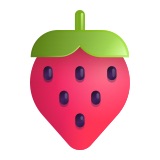
Read aloud: “The first two pictures go together. Which picture goes with the strawberries in the same way?”

Show the answer
Answer: A. Five carrots became six carrots: one more of the same thing. Two strawberries become three strawberries. Three carrots has the right number but the wrong thing.
An original practice question from Thinkling, in the same format as the test. Not a real test item.
Question 5: Number puzzles
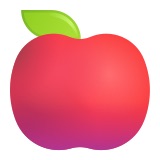
Read aloud: “Both trains should carry the same number of apples. Which car finishes the bottom train?”

Show the answer
Answer: A. The top train carries 3 + 5 = 8 apples. The bottom train has 4, so it needs 4 more: 4 + 4 = 8.
An original practice question from Thinkling, in the same format as the test. Not a real test item.
Question 6: Number series
Read aloud: “The beads on the abacus follow a pattern. Which rod comes next?”
- Choice A
- Choice B
- Choice C
Show the answer
Answer: C. Each rod has 2 more beads than the one before: 2, 4, 6, 8… so the next rod has 10.
An original practice question from Thinkling, in the same format as the test. Not a real test item.
Question 7: Figure matrices
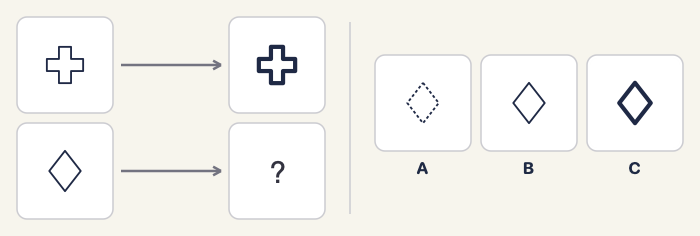
The plus sign changes in a certain way. Which answer shows the diamond changed in the same way?
Show the answer
Answer: C. The outline gets thicker, so the thin diamond becomes a thick diamond. B is unchanged and A changes the line style in a different way.
An original practice question from Thinkling, in the same format as the test. Not a real test item.
Question 8: Paper folding
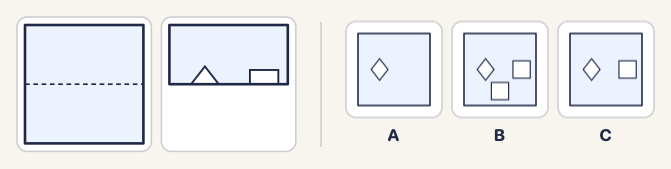
The folded paper is cut along the fold. What does it look like unfolded?
Show the answer
Answer: C. A cut on the fold opens up into a shape twice as big: the triangle becomes a diamond and the half-rectangle becomes a square.
An original practice question from Thinkling, in the same format as the test. Not a real test item.
Question 9: Figure classification
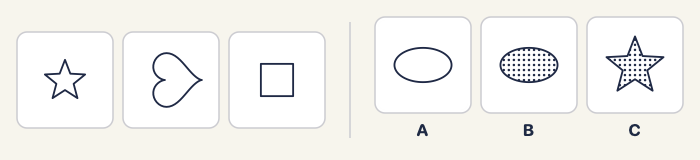
The three shapes on the left are alike in some way. Which answer goes with them?
Show the answer
Answer: A. All three shapes are white inside, whatever their shape. The white oval fits; the dotted star has the right shape family but the wrong shading.
An original practice question from Thinkling, in the same format as the test. Not a real test item.
Part 2: Grades 3–5 (words and numbers)
Your child reads these alone. The verbal and quantitative questions now use words and numbers instead of pictures.
Question 10: Verbal analogies
Eye is to glasses as hand is to…
- glassesChoice A
- spiderChoice B
- glovesChoice C
Show the answer
Answer: C. You wear glasses on your eyes and gloves on your hands. “Glasses” repeats the first pair, a common trap.
An original practice question from Thinkling, in the same format as the test. Not a real test item.
Question 11: Number analogies
Find the rule in the first two pairs. Which number completes the last pair?
- 16Choice A
- 17Choice B
- 18Choice C
Show the answer
Answer: C. Each number goes up by 2: 8 + 2 = 10 and 20 + 2 = 22, so 16 + 2 = 18.
An original practice question from Thinkling, in the same format as the test. Not a real test item.
Question 12: Number puzzles
Which number should replace the question mark?
- 9Choice A
- 11Choice B
- 14Choice C
Show the answer
Answer: A. Work backward: 14 − 5 = 9, and 9 + 5 = 14.
An original practice question from Thinkling, in the same format as the test. Not a real test item.
Question 13: Number series
Which number comes next?
- 27Choice A
- 29Choice B
- 31Choice C
Show the answer
Answer: B. Each number is 3 less than the one before: 32 − 3 = 29.
An original practice question from Thinkling, in the same format as the test. Not a real test item.
Question 14: Paper folding
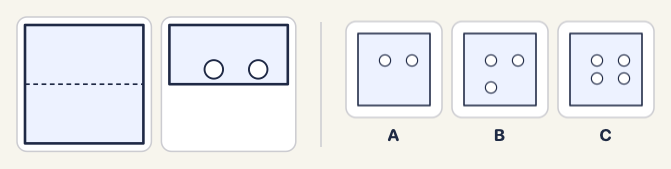
A square sheet is folded in half and two holes are punched. How will it look when it is unfolded?
Show the answer
Answer: C. Each hole goes through both layers, so every hole appears twice, mirrored across the fold line: four holes in all.
An original practice question from Thinkling, in the same format as the test. Not a real test item.
Answer key
- A (cheese). A rabbit eats a carrot, so a mouse eats cheese.
- B (bee). Bees make honey; the spider and butterfly don’t.
- B (whale). A shark, a fish and a crab live in the sea, and so does a whale.
- A (three strawberries). Five carrots became six, one more of the same thing, so two strawberries become three.
- A (four apples). The top train carries 3 + 5 = 8 apples, so the bottom train needs 4 + 4 = 8.
- C (ten beads). Each rod has 2 more beads than the one before: 2, 4, 6, 8, then 10.
- C (thick diamond). The outline gets thicker, so the thin diamond becomes a thick one.
- C (a diamond and a square). Shapes cut on the fold open up twice as big: the triangle becomes a diamond, the half-rectangle a square.
- A (white oval). All three shapes are white inside, whatever their outline.
- C (gloves). You wear glasses on your eyes and gloves on your hands.
- C (18). Each pair adds 2: 8 + 2 = 10, 20 + 2 = 22, so 16 + 2 = 18.
- A (9). Work backward: 14 − 5 = 9, and 9 + 5 = 14.
- B (29). Each number is 3 less than the one before, so 32 − 3 = 29.
- C (four holes). Each hole goes through both layers, so it appears twice, mirrored across the fold.
After the test: what to do next
Go through the answer key together, right answers included. Ask “How did you know?” and let your child explain before you do. Then sort any mistakes: a format that was new, a rushed choice, or a question that was genuinely hard. Each calls for something different, and none of them is a problem.
If one type caused trouble, try it with real objects. For Paper Folding, fold a sheet, punch or cut it, and open it up. For number questions, count out snacks. Our sample questions page has the same questions online, with notes on what to watch for in each.
A short printout shows the formats, not readiness for the whole test. For a full rehearsal in the real order, one battery per sitting, see our guide to CogAT practice tests, and for a week-by-week plan, how to prepare for the CogAT.
Frequently asked questions
Is there a free CogAT practice test PDF?
This page works as one. Open your browser’s print dialog and choose Save as PDF as the destination, and you get a PDF with all 14 questions and the answer key. Before you save, leave every “Show the answer” button closed so the answers stay hidden. You can then print the PDF or open it on a tablet.
Can a kindergartner take a printable CogAT practice test?
Yes, with you reading. Kindergartners take Level 5/6, where the teacher reads every question aloud and children answer with pictures, so read each question in Part 1 once and let your child circle a letter. There is no time limit at this level. If attention fades, split Part 1 into three short sittings, one per battery.
Which part should my 1st or 2nd grader do?
Part 1. Levels 7 and 8, usually taken in 1st and 2nd grade, use the same read-aloud picture format as kindergarten, with harder questions. Read each question aloud even if your child reads well, because that is how the real test works at these levels. Part 2 shows the word and number formats that start at Level 9.
Should I time the printable practice test?
Not for K–2: the real test at Levels 5/6 to 8 is untimed and paced by the teacher. From 3rd grade, each real subtest is timed at 10 minutes, but five questions are too few for a meaningful timing. Use this printout to check the formats, and save timed practice for full-length subtests.
Are these real CogAT questions?
No. They are original practice questions from Thinkling, written in the same formats as the CogAT subtests. They are not real test items. Each one has exactly one right answer, explained in the answer key, so you can talk through the reasoning with your child after they finish.