
Nonverbal battery
CogAT Figure Matrices, explained for parents
In a Figure Matrices question, two shapes change in a certain way, and your child has to make the same change to a third shape. It is a picture-only analogy: no reading, no math, just spotting a rule and applying it.

Key takeaways
- Figure Matrices uses only shapes, so it looks the same from kindergarten to 5th grade; what grows is how many things change at once and how subtly.
- In K–2 (Levels 5/6 to 8) the teacher reads the directions and sets the pace; from 3rd grade (Level 9) the subtest is timed at 10 minutes.
- Changes to look for are shading, size, outline, number, turning or flipping, position and shape; older children often see two changes together.
- Solve by saying the change out loud, checking for a second change, predicting the answer, then ruling out near misses like a copy of the top-right box.
- Figure Matrices is the nonverbal subtest on the CogAT Screening Form, and it is easy to practice at home with buttons, blocks and “What changed?” drawings.
On this page
What a Figure Matrices question looks like
Each question is a small grid. In the top row, a shape changes into another shape: a white star becomes a black star, a small circle becomes a big circle, an arrow turns to point the other way. The bottom row starts with a new shape and ends in an empty box with a question mark. Your child looks at the answer choices and picks the one that shows the same change happening to the new shape.
The Figure Matrices subtest is part of the CogAT® Nonverbal battery, together with Paper Folding and Figure Classification. The questions use only shapes, so they look the same in kindergarten and in 5th grade; what changes with age is how many things change at once and how subtle the changes are.
The plus sign changes in a certain way. Which answer shows the diamond changed in the same way?
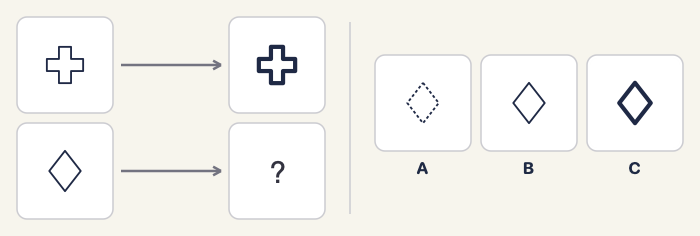
Show the answer
Answer: C. The outline gets thicker, so the thin diamond becomes a thick diamond. B is unchanged and A changes the line style in a different way.
An original practice question from Thinkling, in the same format as the test. Not a real test item.
What it measures
Figure Matrices is an analogy made of pictures. A child has to notice what changed between two figures, put that change into words (even silently), and then apply it to something new. That is the same kind of thinking behind verbal analogies and number analogies, without any words or numbers to lean on.
It also rewards careful looking. Many wrong answers are almost right: the right shape with the wrong shading, or the right shading on the wrong shape. Children who check every part of a figure before choosing do better than children who answer on a first impression.
How many questions there are
The number of Figure Matrices questions grows with each level. The table shows the counts for CogAT Form 7 and Form 8. From Level 9 (usually 3rd grade), the subtest is timed at 10 minutes; at Levels 5/6 to 8 the teacher reads the directions and sets the pace.
| Level | 5/6 | 7 | 8 | 9 | 10–11 |
|---|---|---|---|---|---|
| Usual grade | K | 1st | 2nd | 3rd | 4th–5th |
| Questions | 14 | 16 | 18 | 20 | 22 |
| Timing | Read aloud, teacher-paced | 10 minutes | |||
The changes your child will see
Most questions are built from a short list of changes. Knowing the list helps a child know what to look for:
- Shading: white becomes black, striped or dotted, or the other way around.
- Size: small becomes big, or big becomes small.
- Outline: a thin line becomes thick or dashed.
- Number: one shape becomes two, or three becomes one.
- Turning and flipping: a figure rotates a quarter turn, or flips like a mirror image.
- Position: a small part moves from the top to the bottom, or from inside to outside.
- Shape: one shape becomes another (a square becomes a triangle) while keeping its shading.
Younger children usually see one change at a time. Older children see two changes together, for example “it gets bigger and turns black”, which is where most mistakes happen.
A simple routine for solving them
- Say the change out loud. “The star lost its dots.” Putting it into words makes the rule concrete.
- Check everything else. Did the size change? The outline? The direction? A second change is easy to miss.
- Predict before looking. Picture the answer in your head first, then look for it among the choices.
- Rule out near misses. Cross off any choice with the wrong shape, then any with the wrong shading or size.

If your child picks a wrong answer, ask “What changed in the top row?” before showing the right one. Finding the rule themselves sticks far better than being told.
Common mistakes and how to fix them
Copying the top-right box
One answer choice is often the same as the second figure in the top row. It looks familiar, so it feels right. Teach your child that the answer should look like the bottom shape after the change, not like the top answer.
Seeing only one change
When two things change, children often apply the first one they notice and stop. The “check everything else” step above is the fix, and it gets faster with practice.
Mixing up turns and flips
A quarter turn and a mirror flip can look alike. Cutting a letter-like shape out of paper and physically turning and flipping it on the table makes the difference obvious in a minute.
Practice ideas for home
- Button matrices: lay out a small button, then a big button. Put down a small coin and ask what should come next.
- “What changed?”: draw a shape, then draw it again with one change. Take turns guessing, then try two changes.
- Block towers: a red block on top of a blue one becomes a blue block on top of a red one. What happens to a yellow-on-green tower?
Thinkling turns these same ideas into short daily practice: questions get a little harder only when your child is ready, and when a figure-matrix answer is wrong, the explanation shows the change step by step before your child tries again. For the bigger picture, see how to use CogAT practice tests and our grade-by-grade guides.
Frequently asked questions
What is a figure matrix on the CogAT?
A figure matrix is a small grid of shapes. The top row shows a shape and how it changes, for example a white square that becomes a black square. The bottom row starts with a new shape and an empty box, and the child picks the answer that shows the same change happening to the new shape.
Is Figure Matrices the hardest part of the CogAT?
Not for every child. Children who enjoy puzzles and drawing often find it one of the friendlier subtests, while others find the picture-only format tricky at first. Because it needs no reading, it is also one of the easiest subtests to practice at home with blocks, buttons or paper shapes.
Is Figure Matrices on the CogAT Screening Form?
Yes. The CogAT Screening Form uses three subtests, one from each battery: Verbal Analogies, Number Analogies and Figure Matrices. If your school gives the screener, Figure Matrices is the only nonverbal subtest your child will see.
How long should my child practice figure matrices?
A few minutes at a time is plenty. Short, regular practice with a calm explanation of each mistake usually works better than long sessions. Stop while your child is still enjoying it, and mix figure matrices with other question types so practice does not feel like a drill.
How is a figure matrix different from figure classification?
Figure Matrices is about a change: shape A turns into shape B, so what does shape C turn into? Figure Classification is about a group: three shapes share something, so which answer belongs with them? Both use the same kind of pictures, but they ask different questions.