
Test comparison
CogAT vs. NNAT: how the two tests compare
The CogAT measures reasoning in three areas (verbal, quantitative and nonverbal) across nine subtests. The NNAT, the Naglieri Nonverbal Ability Test, is nonverbal only: every question is built from shapes and figures. The two overlap most in shape-based reasoning, so that is where practice supports both.

Key takeaways
- The CogAT has three batteries (Verbal, Quantitative and Nonverbal) with nine subtests; the NNAT, published by Pearson, is nonverbal only.
- NNAT questions are built from shapes and figures and involve pattern completion, reasoning by analogy, serial reasoning and spatial visualization.
- Some schools use nonverbal tests so that language matters less, for example for a child who is still learning English.
- The CogAT’s Nonverbal battery (Figure Matrices, Paper Folding, Figure Classification) is the closest match to the NNAT, so shape practice helps with both.
- Ask your school which test, which form or edition, and which format your child will take before you plan any practice.
On this page
The short answer
The CogAT® (Cognitive Abilities Test) and the NNAT® (Naglieri Nonverbal Ability Test, published by Pearson) are two separate reasoning tests. Schools may use either one to help identify children for gifted and talented programs.
The biggest difference is breadth. The CogAT looks at three kinds of reasoning, in a Verbal, a Quantitative and a Nonverbal battery. The NNAT looks at one: every question is built from shapes and figures, with no words in the questions themselves. Where the two meet is shape-based reasoning, and that is where practice helps with both.
CogAT vs. NNAT at a glance
This table sticks to what we can state with confidence. “Ask your school” means the answer depends on the version your child takes or on how your school gives the test.
| At a glance | CogAT | NNAT |
|---|---|---|
| Full name | Cognitive Abilities Test | Naglieri Nonverbal Ability Test |
| Current version | Form 7 and Form 8 | NNAT3 |
| What it covers | Verbal, quantitative and nonverbal reasoning | Nonverbal reasoning only |
| How it is organized | 3 batteries, 3 subtests each (9 in total) | Ask your school |
| What the questions use | Pictures, words, amounts, numbers and shapes | Shapes and figures |
| Kinds of thinking | Analogies, sorting into groups, completing sentences, number patterns and puzzles, figure matrices, paper folding | Pattern completion, reasoning by analogy, serial reasoning, spatial visualization |
| Kindergarten to 2nd grade | Read aloud by the teacher; picture-based; no reading needed; untimed, teacher-paced | Ask your school |
| 3rd grade and up | Children read on their own; 10 minutes per subtest | Ask your school |
| Scores | Compared with children of the same age and grade (percentile ranks, stanines, Standard Age Scores) | Ask your school |
What each test measures
The CogAT: three kinds of reasoning
The CogAT measures learned reasoning skills in three areas. The Verbal battery is thinking with words and ideas, the Quantitative battery is thinking with amounts and numbers, and the Nonverbal battery is thinking with shapes. Each battery has three subtests:
Verbal battery
Words, pictures and the ideas behind them.
- Verbal AnalogiesTwo pictures that go together, then a third picture: the child picks the picture that goes with it in the same way.
- Sentence CompletionA question is read aloud and the child picks the picture that answers it.
- Verbal ClassificationThree pictures that belong together; the child picks the picture that belongs with them.
Quantitative battery
Numbers, amounts and number patterns.
- Number AnalogiesPictures of amounts change by a rule (for example, one more); the child applies the same rule.
- Number PuzzlesTwo trains carry objects; the child finds the car that makes both trains hold the same number.
- Number SeriesBeads on an abacus follow a pattern; the child picks the rod that comes next.
Nonverbal battery
Shapes, patterns and spatial thinking.
- Figure MatricesTwo shapes change in a certain way; the child changes a third shape the same way.
- Paper FoldingA sheet of paper is folded, then holes are punched or shapes cut; the child picks how it looks unfolded.
- Figure ClassificationThree shapes are alike in some way; the child picks the shape that belongs with them.
In kindergarten to 2nd grade (Levels 5/6 to 8), the teacher reads every question aloud and the questions are picture-based, so no reading is needed. From 3rd grade (Level 9), children read on their own and each subtest is timed at 10 minutes. Our CogAT guide has the full picture.
The NNAT: shapes and figures only
The NNAT asks every question with figures. Its questions involve skills such as:
- Pattern completion: a design has a missing piece, and the child picks the piece that lets the pattern continue.
- Reasoning by analogy: one figure changes in a certain way, and the child applies the same change to another figure.
- Serial reasoning: figures change step by step, and the child works out what comes next.
- Spatial visualization: the child pictures how shapes turn, fit together or combine.
Details such as timing, levels and score types depend on the version your child takes, so we leave those to your school. Our NNAT guide explains each kind of question in more depth.
Why some schools use a nonverbal-only test
Some schools use nonverbal tests so that language matters less. A question made of shapes doesn’t ask a child to read or to know a lot of English words. A child who is still learning English, or whose vocabulary is still catching up, can work through it without the words getting in the way.
That doesn’t make one test better than the other. A broad test like the CogAT shows a profile across words, numbers and shapes, while a nonverbal test focuses on one kind of thinking. Schools also usually look at several kinds of information, such as teacher observations and work samples, not just one test. If you want to know why your school chose its test, it’s a fair question to ask.
Where the skills overlap
The CogAT’s Nonverbal battery is the closest match to the NNAT. The formats differ, but the thinking is closely related:
- Figure Matrices: find how one figure changes and apply the same change to a new one. This is reasoning by analogy with shapes.
- Paper Folding: picture where the holes appear when a folded, punched paper is opened. This is spatial visualization.
- Figure Classification: work out what a group of figures has in common. It builds the careful comparison that pattern questions need.
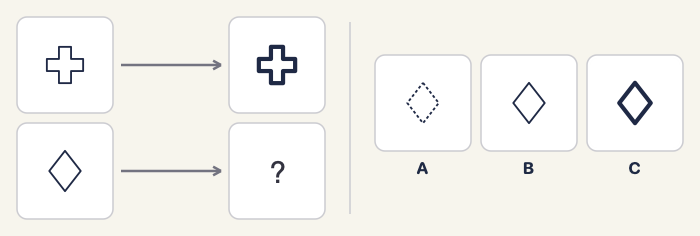
The plus sign changes in a certain way. Which answer shows the diamond changed in the same way?
Show the answer
Answer: C. The outline gets thicker, so the thin diamond becomes a thick diamond. B is unchanged and A changes the line style in a different way.
An original practice question from Thinkling, in the same format as the test. Not a real test item.
The sample is an original practice question in the CogAT Figure Matrices format, not a real CogAT or NNAT item. The habit it trains, finding the change, saying it in words and then applying it, is useful on both tests.
The CogAT’s Verbal and Quantitative batteries have no direct NNAT counterpart. Even so, the “find the rule, then predict” idea behind a number pattern is the same idea behind a series of changing shapes.
How to prepare for each
If your child takes the NNAT
Focus on shapes. Build patterns with blocks or buttons and leave a gap to fill, fold and punch paper, turn cut-out shapes on the table, and ask your child to say each rule out loud: “It turns a little more each time.” A few minutes on most days is plenty.
If your child takes the CogAT
Do the same shape work, then add words and amounts: “what goes together” games, sorting toys into groups and simple number patterns. In K–2, practice listening to the whole question before answering. From 3rd grade, practice moving on calmly from a question that is taking too long. A practice test a week or two ahead helps the format feel familiar.
Habits that help on both
- Look at every part of a figure: shape, size, shading, direction and position.
- Name the rule in words before looking at the answer choices.
- Picture the answer, then find the choice that matches it.
- Check the chosen answer against the rule once more.
Thinkling is built mainly for the CogAT, with all nine question types in the real formats, and it also includes NNAT-style practice with pattern completion, figure series and matrices. Its questions are original practice questions, not real test items.
Ask your school which test and which form
Practice works best when it matches the test your child will actually take, so start with a short note to the teacher. Useful questions:
- Which test will my child take: the CogAT, the NNAT, the OLSAT® or something else?
- Which form, edition or level? For the CogAT, is it the full test or the shorter Screening Form?
- Will it be on paper or online?
- When is it, and how are results shared with families?
- What other information does the school look at besides the test?
If the answer is “more than one test,” the shared habits above cover the overlap. Our CogAT vs. OLSAT comparison covers the other test families often hear about.
Frequently asked questions
What is the Naglieri test?
“The Naglieri test” usually means the NNAT, the Naglieri Nonverbal Ability Test, published by Pearson. It is a nonverbal reasoning test: its questions are made of shapes and figures rather than words, and they involve skills such as pattern completion, reasoning by analogy, serial reasoning and spatial visualization. NNAT3 is the current edition. Your school can tell you how and when it is given.
Is the NNAT easier than the CogAT?
There is no fair way to call one of them easier. They are separate tests with their own questions and their own scoring. A child who loves puzzles and shapes may feel at home on the NNAT, while a child who enjoys words and numbers may find parts of the CogAT friendlier. Familiarity with the format and a calm test day matter more than which test it is.
Does CogAT practice help with the NNAT?
Partly. The CogAT’s Nonverbal battery, made up of Figure Matrices, Paper Folding and Figure Classification, uses closely related shape-based thinking, so that practice carries over well. The Verbal and Quantitative batteries have no direct NNAT counterpart. The formats are not identical either, so treat CogAT-style practice as support for the shared skills rather than as a copy of the NNAT.
Why would a school use the NNAT instead of the CogAT?
Schools choose their own tests, and we can’t speak for any of them. In general, some schools use nonverbal tests so that language matters less, since a question made of shapes does not depend on reading or on English vocabulary. If you are curious about your school’s choice, it is reasonable to ask which test is used, in which grades, and how results are used.
Can NNAT and CogAT scores be compared?
Not directly. Each test has its own scoring, so a number from one should not be read as if it came from the other. CogAT results compare a child with children of the same age and the same grade, using percentile ranks, stanines and Standard Age Scores. For how the NNAT is reported, and how your school uses either result, ask your school or district.